When Pilates studio owners want to purchase Pilates reformers, they often focus on the frame, carriage, upholstery, or overall appearance. Pilates springs usually receive far less attention.
From my experience, that is a mistake.
The spring system is the heart of every Pilates reformer. Every movement depends on how the springs stretch, return, and transfer resistance to the user. A poorly Pilates spring can reduce training quality, increase maintenance costs, and even create safety risks after years of usage.
I have visited some Pilates equipment factories over the past 6 years. I have also worked with studio owners, distributors, brand owners and wholesalers around the world.
Many buyers compare spring colors. or ask total same Balanced Body®, Merrithew®, BASI® springs, just these brands spring alternatives.
Customers will inquire about the number and color of springs that are paired with each Pilates reformers.
Whether you are opening your first studio or purchasing equipment for multiple locations, understanding how Pilates springs are designed and what should be checked before will help you make a better long-term investment.
Pilates reformer springs determine resistance, carriage performance, durability, and long-term maintenance. Commercial buyers should evaluate spring wire diameter, coil design, material quality, fatigue life, and reliable quality instead of relying only on spring colors or resistance labels.

Table of contents
- Why Do Pilates Springs Matter?
- Understanding Pilates Reformer Spring Resistance
- Pilates Springs for High-Frequency Pilates Studio Use: What Buyers Should Check
- What Determines the Quality of a Pilates Reformer Spring?
- Why Reformer Spring Resistance Is Not Always the Same Between Manufacturers
- Colour-Coded Pilates Reformer Springs: How Buyers Compare Resistance Levels
- Pilates Reformer Springs: Studio Owner Reference Table
- What Spring Specifications Should Be Included in a Pilates Reformer?
- How Spring Diameter and Coil Design Affect Reformer Performance
- How Spring Length Influences Pilates Reformer Resistance and Carriage Feel
- Conclusion
Why Do Pilates Springs Matter?
Many Pilates owners spend weeks comparing Pilates reformer frames, carriages, and upholstery before placing order.
Very few spend the same amount of time evaluating the springs, this is one of the biggest purchasing mistakes of a buyer can make.
A Pilates reformer spring is much more than a piece of coiled steel wire. It is the core of the reformer’s resistance. Every movement, every exercise, and every level of training depends on how the springs stretch, return, and transfer force to the carriage.
Without Pilates springs, a reformer is simply a platform that rolls on rails.
Unlike traditional weight machines that use fixed loads, Pilates reformers use progressive resistance. As the carriage moves away from the frame, the springs gradually stretch and the resistance increases. This creates smoother movement, better muscle control, and lower impact on the joints throughout the entire range of motion.
What makes Pilates unique is that the Pilates springs do not only provide resistance—they also provide assistance.
When clients push or pull against the springs, they build strength, strengthen the body core, and movement control. At the same time, the springs can support body weight during challenging movements, allowing beginners, rehabilitation patients to perform the same exercise with different spring settings.
This dual function is one of the reasons Pilates equipment has remained relevant for nearly a century. Instead of changing weights or replacing machines, instructors simply adjust the spring combination to match different clients, training goals, and physical abilities.
Light springs demand greater balance, coordination, and core stability because they provide less support. Medium springs create a balanced combination of assistance and resistance, making them suitable for general training and skill development. Heavy springs increase the workload on larger muscle groups while offering additional support during movement, making them ideal for strength-focused exercises.
For Pilates studios, springs influence much more than exercise difficulty.
They determine:
- The smoothness of carriage movement.
- The safety of dynamic exercises.
- The overall training experience.
- Long-term maintenance requirements.
- Equipment lifespan.
A reformer with inconsistent or low-quality springs may still look premium, but instructors will quickly notice differences in resistance, carriage control, and exercise progression after months of commercial use.
You are not simply buying springs. You are investing in every class your studio will teach for the next ten years.
Pilates reformer springs are the heart of the resistance system. They provide both assistance and progressive resistance, allowing one reformer to support rehabilitation, beginner, and advanced training. For commercial buyers, spring quality directly affects movement consistency, equipment safety, maintenance costs, and long-term studio performance.
Springs Make Pilates Different from Traditional Strength Training
The biggest difference between a Pilates reformer and a traditional weight machine is the resistance system.
Traditional gym equipment relies on fixed weights. The resistance remains relatively constant throughout the movement.
A Pilates reformer works differently.
As the carriage moves, the springs gradually stretch, creating progressive resistance. This closely follows how muscles naturally produce force during movement, allowing exercises to feel smoother and easier to control while reducing unnecessary stress on the joints.
This is why Pilates is widely used for rehabilitation, athletic performance, and general fitness.
Springs Both Assist and Challenge Movement
Unlike traditional weight machines, Pilates springs do more than create resistance. They also support the body during movement, allowing the same reformer to adapt to different users and training goals. By adjusting the spring combination, instructors can reduce assistance or increase resistance as clients progress from rehabilitation and beginner training to advanced strength and control exercises. This flexibility is one of the reasons a commercial Pilates reformer can serve such a wide range of clients.
Spring Selection Changes the Training Goal
Changing the spring combination does much more than increase or decrease resistance.
It changes what the body is being asked to do.
| Spring Resistance | Primary Training Focus |
| Light | Core stability, balance, eccentric control, movement precision |
| Medium | Balanced strength, coordination, and technique development |
| Heavy | Strength, power, larger muscle recruitment, additional movement support |
Why Spring Quality Matters to Pilates owners
From an engineering perspective, the spring is one of the hardest-working components on a Pilates reformer or others Pilates equipment.
Every class requires the Pilates springs to stretch and return repeatedly.
Over years of use, they may complete hundreds of thousands of loading cycles.
Because of this, Pilates owners should evaluate spring quality as carefully as they evaluate the frame or carriage.
High-quality springs provide:
- Consistent resistance across every reformer.
- Smooth carriage movement. Nowadays, it is claimed to be silent on the market.
- Better movement control.
- Lower maintenance costs.
- Longer service life.
These characteristics influence not only equipment durability but also instructor confidence and client satisfaction.
Understanding Pilates Reformer Spring Resistance
Pilates spring color does not create resistance. Spring engineering does.
A Pilates reformer generates resistance through the elastic tension of steel springs. As the carriage moves away from the spring bar, the springs stretch and produce increasing force. Unlike traditional weight machines that provide constant resistance, Pilates reformers create progressive resistance. The farther the springs stretch, the greater the resistance becomes. This changing resistance allows movements to feel smooth at the beginning and more challenging toward the end of the exercise.
For Pilates owners or Pilates enthusiast, understanding this principle is far more valuable than simply memorizing spring colors.
Pilates reformer spring resistance is created by the controlled extension of engineered steel springs, not by spring color. Wire diameter, material, coil geometry, spring length, heat treatment and spring rate determine how the reformer feels throughout the movement.
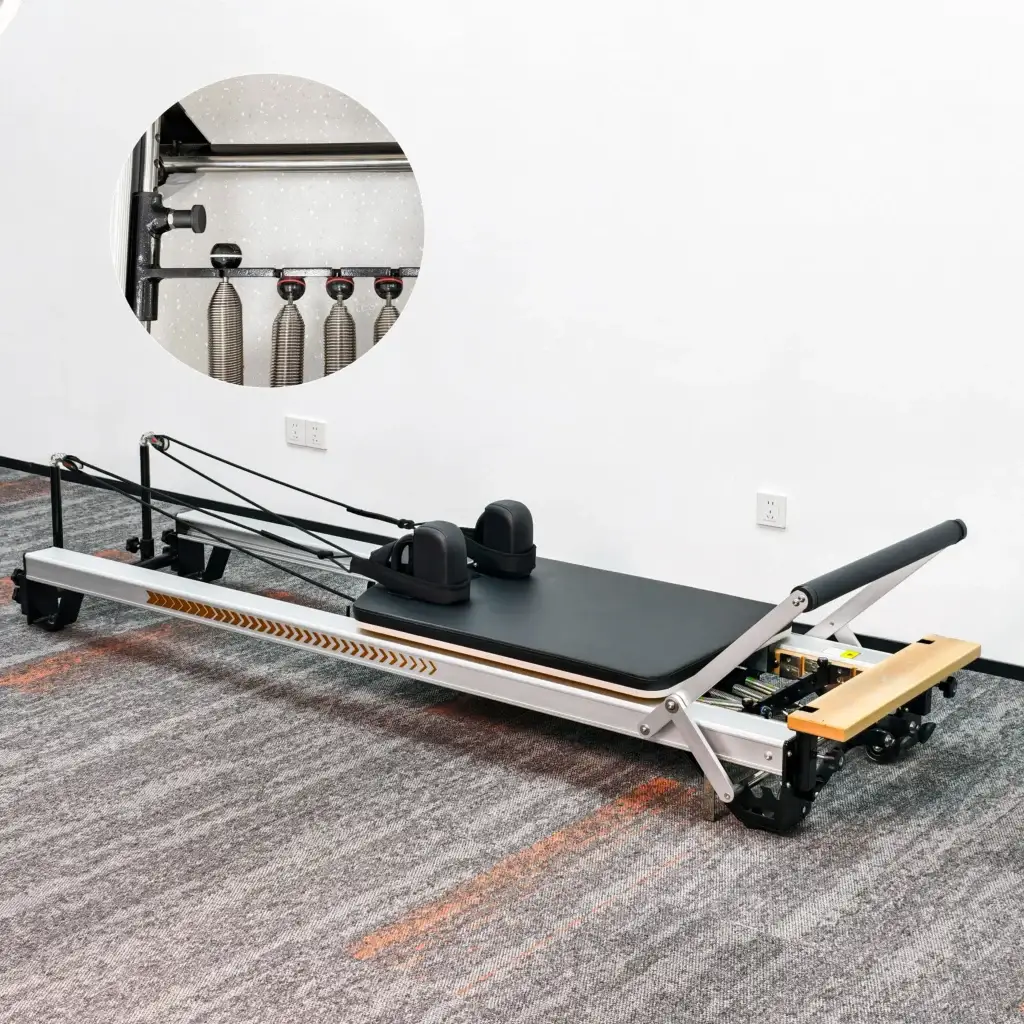
Spring Resistance Is Based on Engineering
Every Pilates spring follows the same mechanical principle.
As the spring stretches, its tension increases. The carriage becomes progressively harder to move, creating a smooth and natural resistance curve that matches the body’s movement.
This is one reason Pilates feels very different from traditional strength training. Instead of lifting a fixed load, users experience resistance that continuously changes throughout the exercise, improving movement control, stability, and coordination.
Spring Color Is Only an Identification
One of the biggest misunderstandings I see is that buyers believe spring colors represent an industry standard.
They do not.
The number and color of springs on each Pilates reformers follow the training system or origin brand of Pilates reformers
So, each manufacturer develops its own spring system, which means the same color can represent completely different resistance levels.
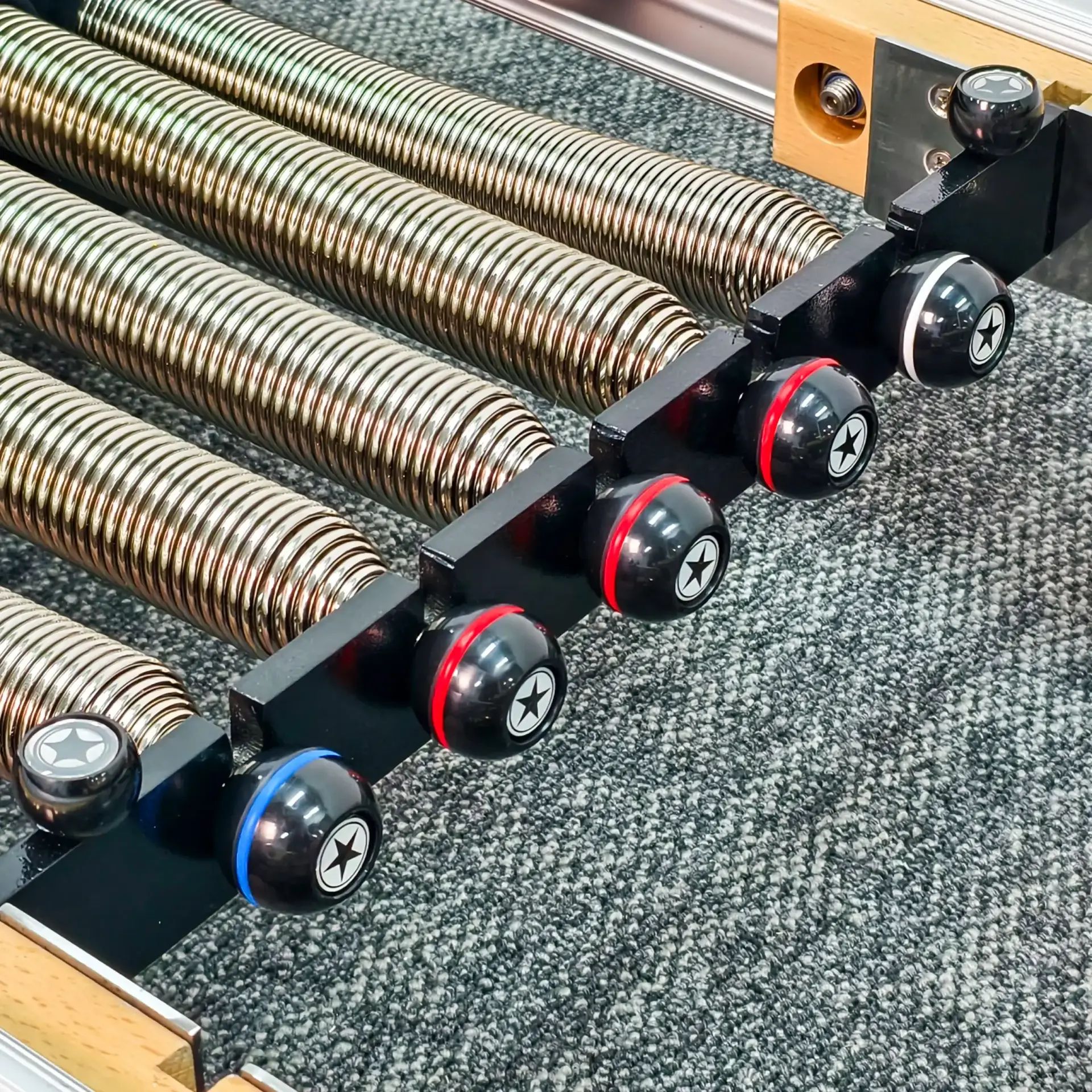
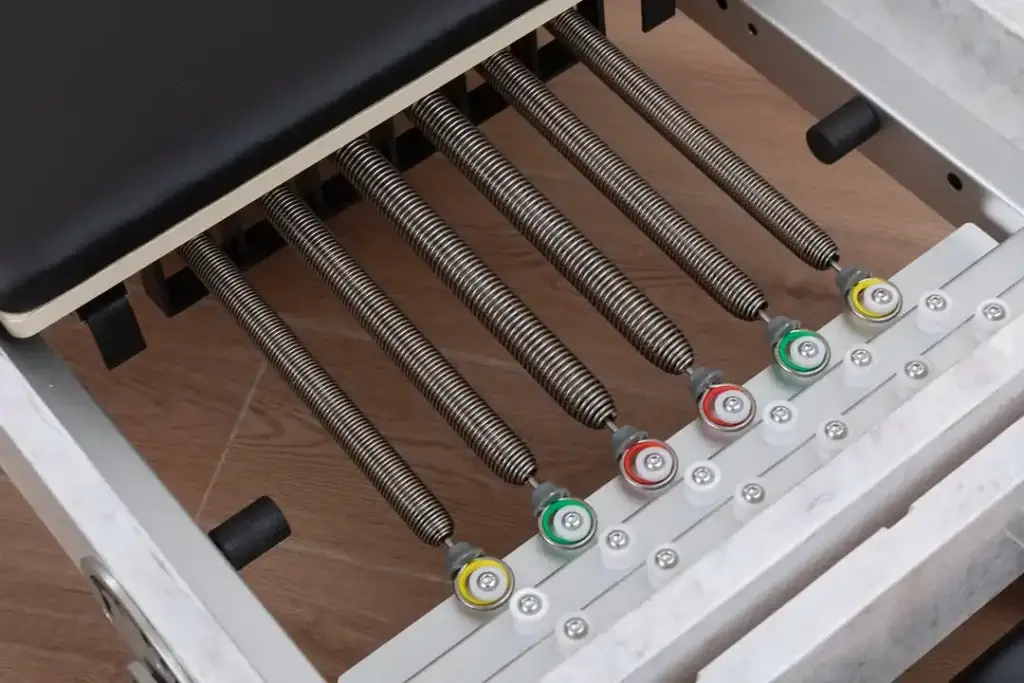
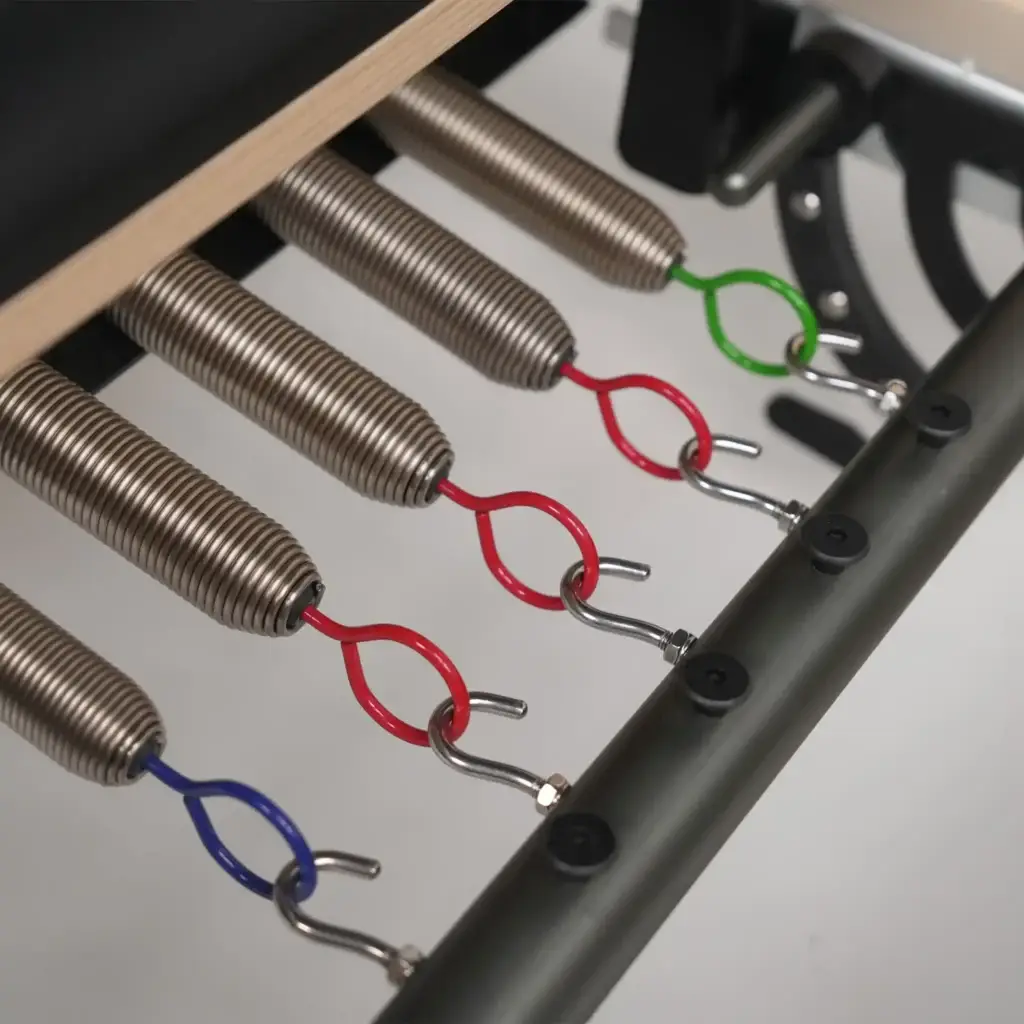
The number and color of springs on each core bed follow the training system or origin brand of the core bed. For example, Reformer of the American Balanced Body series usually have 5 springs. Green increases resistance, red increases resistance, blue increases resistance, and yellow increases resistance. The Reformer models of the Merrithew series in Canada use unique spherical hook springs. Some original Reformer models from China are equipped with six springs, two red ones for heavy resistance, two blue ones for medium resistance, and two yellow ones for light resistance.
[https://www.merrithew.com/docs/default-source/distributors—customer-service/spring-resistance-chart?srsltid=AfmBOoqYuDaWmPOGC-qErIMIOzqa5ZneBk7qVhwBChsz5TQbJEwCMngg]
| Manufacturer | Heavy | Medium | Light | ultralight |
| Balanced Body | Green | Red | Blue | Yellow |
| Peak Pilates | Red | Yellow | Blue | Yellow |
| Merrithew (STOTT) | Black | Red | Blue | White |
| BASI | Red | Blue | Yellow | |
| Some original Chinese reformer models are equipped with six springs. Two red ones offer heavy resistance, two blue ones offer medium resistance, and two yellow ones offer light resistance | ||||
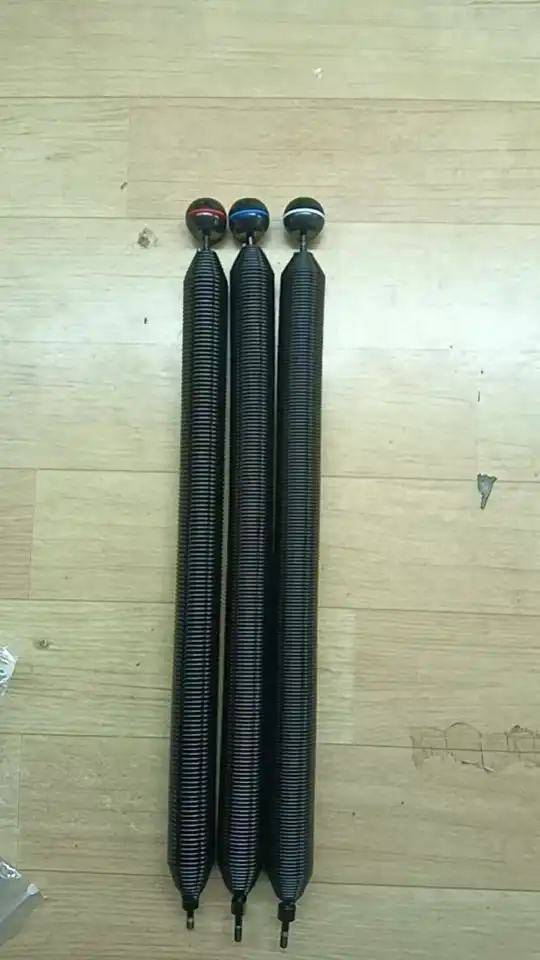
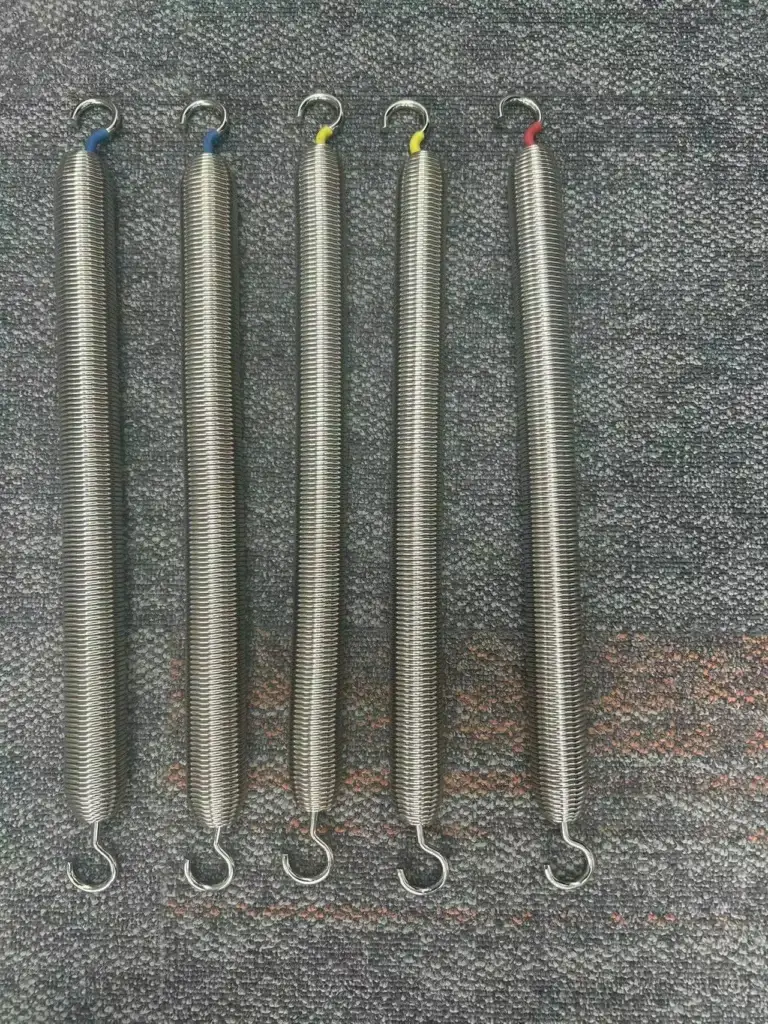
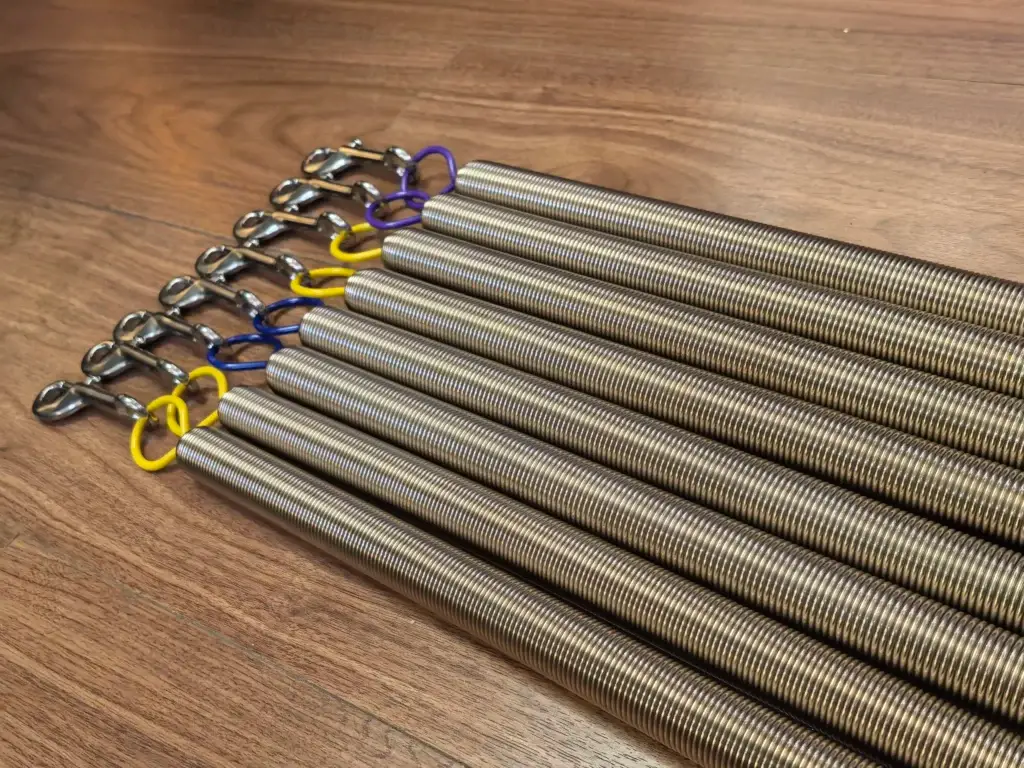
What Pilates Owners Should Ask Pilates equipments Manufacturers
When evaluating Pilates reformers, I recommend asking questions that go beyond spring colors.
For example:
- What spring steel is used?
Answer: Warrior Pilates uses premium imported piano wire sourced from leading suppliers in South Korea and Germany to manufacture all Pilates springs.
Only high-carbon piano wire provides the combination of strength, fatigue resistance, and elastic recovery required for long-term commercial use and professional training. Standard carbon steel and stainless steel springs cannot deliver the same level of performance or durability.
- Are all springs tested before assembly?
Answer: All the springs of Warrior Pilates have their resistance values tested before assembly to meet the standards of this color. The durability and corrosion resistance of each batch of Pilates springs are tested by random inspection.
- What fatigue testing has been completed?
Answer: German-imported piano wire springs were stretched to 120 cm and tested for 1 million cycles. After testing, the resistance decreased by only 0.27 kg, and the springs remained fully functional with no structural damage.
South Korean imported SWP-B piano wire springs were also stretched to 120 cm and tested for 1 million cycles. After testing, the resistance decreased by only 0.9 kg, while the springs remained structurally intact and suitable for continued commercial use.
- How many extension cycles are the springs designed to withstand?
Answer: More than or equal to 700,000 times extension cycles.
- Can replacement springs match the original resistance after several years?
Answer:Keep your equipment operating safely and at optimal performance by replacing your springs every two years
These questions reveal much more about product quality than simply asking whether the reformer uses red, blue, or yellow springs.
Pilates Springs for High-Frequency Pilates Studio Use: What Buyers Should Check
Many Pilates reformers perform very well when they are new recently years.
The real test begins after thousands of studio classes.
Pilates studios working environment is completely different from home users or Pilates enthusiast. A home reformer perhaps used three or four times each week. A Pilates studio reformer will support four to eight classes every day. So the difference training places enormous demands on the spring.
When I evaluate a reformer for commercial use, I want to know how they will perform after hundreds of thousands of extension cycles.
High-frequency Pilates studios require springs with excellent fatigue resistance, consistent spring rates, and reliable long-term performance. Buyers should evaluate fatigue life, material quality, heat treatment, manufacturing consistency, and replacement support before ordering commercial Pilates reformers.
Commercial Springs Experience Continuous Fatigue
Every time a client moves the carriage, the springs stretch and return.
That single movement seems simple.
From an engineering perspective, it is a fatigue cycle.
A commercial reformer may complete several hundred spring cycles every day.
Over one year, that number can easily reach hundreds of thousands of extension cycles.
Unlike a frame or carriage, springs are designed to deform repeatedly.
Their ability to maintain consistent resistance depends on one critical property:
Fatigue resistance.
If fatigue performance is poor, the spring gradually loses its original characteristics.
It may become shape change.
It may return more slowly. At last, the spring may no longer provide the resistance expected by the instructor.
That is why I consider fatigue life one of the most important specifications for Pilates studio reformers.
High-Quality Spring Steel Makes a Difference
Not all spring steel performs the same.
Commercial manufacturers should select high-quality spring steel specifically designed for repeated cyclic loading.
The manufacturing process is equally important.
Spring performance depends on:
- Material composition
- Wire drawing quality
- Heat treatment
- Stress relief
- Surface finishing
- Dimensional accuracy
A spring made from excellent steel can still perform poorly if these processes are not properly controlled.
Likewise, excellent manufacturing cannot fully compensate for low-grade raw material.
For commercial buyers, both the material and the manufacturing process deserve careful attention.
Resistance Should Keep Stable Over Time
Many Pilates studio buyers compare reformers only when they are brand new.
But the more important question is:
Will the Pilates spring feel the same after two years of daily use?
Professional Pilates studios depend on consistency.
Pilates instructors build class programs around predictable spring resistance.
If one reformer gradually becomes lighter than another, clients notice subtle differences, and instructors lose confidence in the equipment.
Maintaining resistance consistency throughout the spring’s service life is therefore far more important than having high resistance on the first day.
Replacement Planning Is Part of Commercial Pilates Ownership
Every Pilates spring has a service life.
Replacing Pilates springs is not a sign that the reformer has failed.
It is normal preventive maintenance.
Professional studios should develop a spring management plan that includes:
- Regular visual inspection
- Checking for deformation or corrosion
- Monitoring resistance consistency
- Replacing complete spring sets when necessary
- Keeping compatible replacement springs in stock
Replacing Pilates springs before problems comes up helps maintain teaching quality while reducing the risk of unexpected Pilates equipment downtime.
For large studios and multi-location Pilates owners, preventive replacement is usually much more cost-effective than waiting for problems to appear.
What Determines the Quality of a Pilates Reformer Spring?
When buyers compare Pilates reformers, they often compare the number of springs, the spring colors, or the advertised resistance levels.
From my experience, none of these tells me whether the Pilates spring is actually high quality.
A commercial Pilates spring is a precision-engineered mechanical component. Every Pilates spring stretches and contracts hundreds of thousands of times during its service life. If the material, manufacturing process, or quality control is in and out, the spring may gradually lose resistance, create uneven movement, or require premature replacement.
That is why I always tell commercial buyers:
Do not judge a spring by its appearance. Judge it by how it is engineered.
The quality of a Pilates reformer spring depends on much more than its color or resistance level. Spring steel, wire diameter, heat treatment, fatigue life, manufacturing precision, and quality inspection all determine how consistently the spring performs throughout years of commercial use.
Spring Steel Determines Fatigue Life
Every commercial Pilates spring begins with one decision. The one is important: Which steel will be used?
This decision influences almost every aspect of the Pilates spring’s performance.
Commercial-grade Pilates spring steel must repeatedly stretch and return to its original length without permanent deformation.
If the steel has poor mechanical properties or inconsistent composition, microscopic cracks gradually develop during repeated loading.
Eventually the spring loses resistance or fails completely.
High-quality spring steel provides:
- Better fatigue resistance
- More consistent resistance
- Longer service life
- Greater dimensional stability
- Better safety during commercial use
For a busy Pilates studio, these characteristics matter far more than cosmetic appearance.
Wire Diameter Changes More Than Resistance
Many buyers think thicker wire simply creates a stronger spring.
The reality is much more interesting.
Wire diameter changes:
- Spring stiffness
- Fatigue performance
- Extension characteristics
- Load capacity
- Sitting on the carriage feeling
Increasing the wire diameter generally increases the spring rate.
The carriage feels firmer during movement.
However, making the spring wire unnecessarily thick is not always beneficial.
An oversized spring may reduce exercise control and limit the smooth, progressive resistance that Pilates equipment is designed to provide.
Good manufacturers do not simply select the thickest wire.
They select the wire diameter that matches the intended training experience.
Heat Treatment Is Often Invisible—but Critical
One of the most overlooked manufacturing processes is heat treatment.
Buyers cannot see it.
Clients never notice it.
However, engineers pay close attention to it.
Proper heat treatment relieves internal stresses created during spring forming.
It improves fatigue resistance and helps the spring maintain stable mechanical properties after repeated extension cycles.
Without proper heat treatment, two springs may look identical on the outside while performing very differently after several months of commercial use.
This is one reason why appearance alone tells me very little about spring quality.
Surface Protection Extends Service Life
A spring operates in a demanding environment.
Maintenance and Safety Checklist for Studio Owners
| Inspection point | What to look for | Studio action |
| Coils | Gaps, stretching, uneven spacing, deformation, or kinks | Remove from use and replace |
| Corrosion | Oxidation, rust, pitting, or discoloration | Replace; do not rely on surface cleaning to restore safety |
| Hooks / loops / attachment points | Wear, opening, bending, sharp edges, or loose mounting | Stop using the spring and inspect the full attachment system |
| Spring matching | One spring feels noticeably weaker or longer than the others | Replace as a matched set when appropriate, especially on high-use commercial Reformers |
| Cleaning | Oil, sweat, chemical residue, or cleaning liquid on springs | Keep chemicals and oils away from springs; wipe surrounding equipment carefully |
| Replacement timing | High-use studio equipment, visible wear, or uncertain history | Pilates Anytime gives a general rule of thumb of every two years, but use frequency, manufacturer guidance, and inspection results should control the final decision |
| Cross-brand replacement | A spring “looks similar” but comes from another manufacturer | Do not substitute it. Hook dimensions, spring length, travel, load, and safety margins may differ |
Every day it is exposed to:
- Sweat
- Cleaning chemicals
- Humidity
- Dust
- Continuous movement
A properly finished spring resists corrosion more effectively and maintains a smoother surface throughout its service life.
Surface quality also reduces the likelihood of corrosion becoming the starting point for fatigue cracks.
For commercial studios, good corrosion protection helps extend inspection intervals and improve long-term reliability.
The difference between China Pilates springs and German springs:
The price of German springs is several times that of domestic ones
Pilates studios subject springs to thousands of repeated extensions every day, making spring fatigue one of the biggest maintenance challenges.
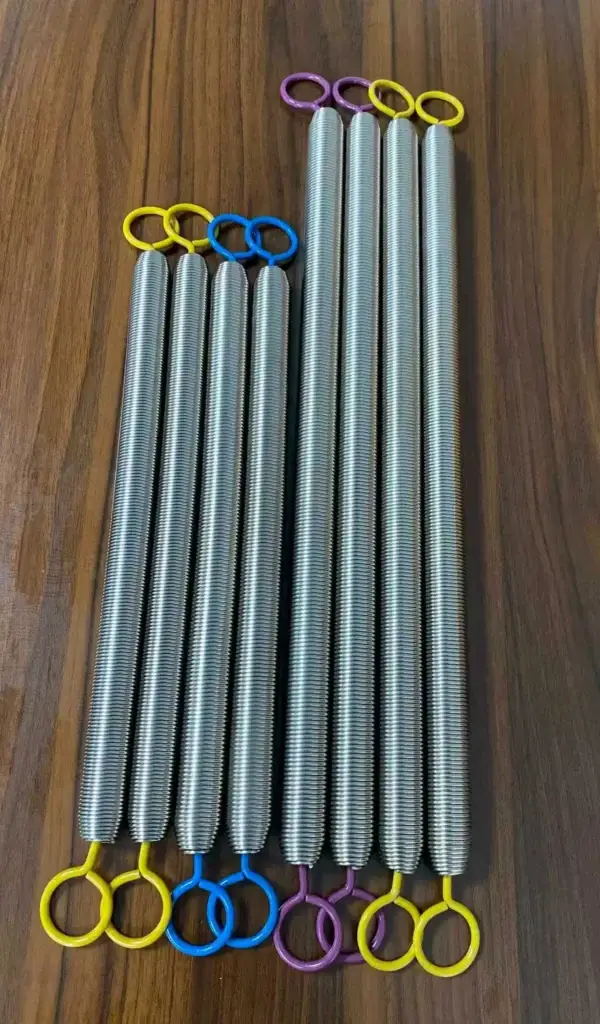
Warrior Pilates uses premium imported high-carbon piano wire sourced from Germany and South Korea. With a carbon content of 0.80%–0.85% and a tensile strength of 2,000–3,480 MPa, these materials deliver significantly higher elasticity, strength, and fatigue resistance than ordinary carbon steel. Springs manufactured from premium Roslau (Germany) or Kiswire SWP-B (South Korea) piano wire can withstand 500,000 to 1,000,000 extension cycles while maintaining less than 5% resistance loss.
By comparison, low-cost springs made from ordinary carbon steel typically begin to experience permanent deformation after approximately 40,000 cycles. They gradually lose resistance, become permanently elongated, and often require replacement within one to three months in high-frequency commercial studios, significantly increasing maintenance costs.
Premium imported piano wire offers excellent elastic recovery, allowing the spring to return to its original length after repeated stretching. It also maintains consistent resistance across different spring levels over years of commercial use, reducing the need for frequent recalibration or replacement.
Although German-imported piano wire costs approximately five to ten times more than the materials commonly used in low-cost domestic Pilates springs, the longer service life, greater performance stability, and lower maintenance requirements make it a more economical choice for professional studios over the long term.
Why Reformer Spring Resistance Is Not Always the Same Between Manufacturers
One question I hear from Pilates equipments distributors and studio owners is:
“Why do two reformers with the same spring colors feel completely different?”
It is good question. Many buyers assume that a red spring from one manufacturer provides exactly the same resistance as a red spring from another.
Unfortunately, there is no universal international standard for Pilates reformer spring resistance.
Each manufacturer develops its own spring specifications, resistance curves, manufacturing tolerances, and testing methods.
That means two Pilates springs with the same color may deliver noticeably different resistance, even if they look almost identical.
For Pilates owners, understanding this difference is essential before placing an order.
Spring color is not an international resistance standard. Different Pilates equipment manufacturers use different spring rates, wire diameters, coil designs, and manufacturing tolerances. Pilates owners should compare technical specifications and resistance consistency instead of relying only on Pilates spring colors.
Spring Colors Are Identification Systems—Not Engineering Standards
Many people believe spring colors represent fixed resistance values.
They do not.
Spring colors were originally introduced to help instructors quickly identify different resistance levels during training.
They improve efficiency during classes.
However, the colors themselves do not define the spring’s mechanical performance.
For example, a blue spring from Manufacturer A may have a different spring rate from a blue spring produced by Manufacturer B.
Both manufacturers may describe the spring as “medium resistance.”
Yet the actual force required to stretch the spring can vary considerably.
That is why experienced procurement teams never evaluate spring quality by color alone.
Why Commercial Studios Need Consistent Spring Performance
Imagine teaching the same class on two reformers positioned side by side.
Both machines have identical spring colors.
One reformer feels noticeably heavier.
The other feels lighter.
The instructor now has two choices.
Either adjust the exercises for each client or accept inconsistent training.
Neither option is ideal.
Large commercial studios depend on standardized equipment because it improves:
- Instructor confidence
- Exercise consistency
- Client progression
- Equipment management
- Staff training
- Maintenance planning
This is why professional manufacturers place so much emphasis on resistance consistency throughout production.
Colour-Coded Pilates Reformer Springs: How Buyers Compare Resistance Levels
Walk into almost any Pilates studio and you will see springs in different colors.
Red.
Blue.
Yellow.
Green.
Black.
Most instructors immediately know which spring to choose for an exercise.
Many Pilates buyers assume those colors follow a universal standard.
My answer: No, they do not.
One manufacturer’s red spring may not provide the same resistance as another manufacturer’s red spring.
Understanding this helps buyers compare reformers more accurately and avoid unexpected differences after installation.
Colour-coded Pilates springs help instructors identify resistance quickly, but they are not internationally standardized. Buyers should compare spring specifications, resistance values, and engineering data instead of relying only on spring colors.
Pilates Reformer Springs: Studio Owner Reference Table
The central lesson from both guides: spring color is a brand-specific label, not an industry standard. A “red” spring can be medium, heavy, or even an optional extra-heavy cord depending on the equipment. Teach by the feel and purpose of the movement, not color alone
| Reformer system / brand | Spring or cord configuration | Color-to-strength system | What it means for a studio owner | Training / programming implications | Best purchasing or operating check |
| Classical Reformers — Gratz®, Techno®, Legacy®, Contrology®, Pilates Designs® | Usually 4 equal springs | All four are generally regarded as heavy; no color coding is needed | This is a classical-system approach: teachers create variation mainly by using 1, 2, 3, or 4 equal springs, plus equipment geometry and exercise selection | Familiar for classical teachers; gives a strong, traditional Reformer feel. Less suitable when a very light spring is required for rehabilitation or highly modified work | Ask whether the Reformer uses truly equal springs and request the working resistance curve, spring length, wire diameter, coil count, and preload data—not only “heavy” wording |
| Gratz® | 4 equal springs | Equal heavy springs; Pilates Anytime compares each to a Balanced Body green/heavy spring | A studio using Gratz will need instructors who understand classical spring translation. It should not be treated as a direct color-for-color equivalent to a contemporary Reformer | A lighter setting often requires more control; “fewer springs” is not automatically easier | For a mixed-equipment studio, create an internal spring-setting conversion guide for each exercise and teacher |
| Pilates Designs® | 4 equal standard springs; light and heavy sets may also be available | Standard set: equal resistance | Similar operating logic to a classical Reformer, but confirm the specific spring set installed because optional sets may change the feel | Suitable for studios following traditional repertoire; more limited color cues for new instructors and clients | Confirm which spring package is fitted at shipment and ensure the spare-spring order matches it exactly |
| Balanced Body® | Commonly 5 springs; mixed resistance | Yellow: very light; Blue: light; Red: medium; Green: heavy | One of the clearest and most widely recognized contemporary color systems. Useful for large studios, instructor onboarding, rehab-oriented work, and diverse client levels | Wide progression range. Yellow/blue support detailed cueing and low-load work; red/green provide support and load for stronger movements | Specify the exact set, such as number of red springs, whether a green is included, and whether your instructors want a standard or customized configuration |
| Peak Pilates® | 5 springs: typically 2 blue, 2 yellow, 1 red | Blue: light; Yellow: medium; Red: heavy | Important trap: Peak’s red is heavy, while Balanced Body’s red is medium. A color-based instruction sheet can cause incorrect loading when teachers move between brands | Good mixed-resistance range, but teachers should be trained in Peak terminology rather than relying on Balanced Body habits | Put a Peak-specific spring chart on every Reformer or in your instructor handbook |
| Merrithew® / STOTT® | 5 mixed-resistance springs; spring packages may vary | White: 25% / light; Blue: 50% / medium; Red: 100% / heavy; Black: 125% / extra-heavy | A percentage-based system is useful for commercial studios because it communicates relative loading clearly. Still, percentages are relative within that brand—not a universal kilogram or pound rating | Appropriate for studios serving beginners, general fitness clients, athletic clients, and modified programs. The lighter white spring gives more low-load options | Ask suppliers to define whether their claimed “100%” spring is benchmarked to a specific spring force at a stated extension length |
| Flexia™ | 5 mixed-resistance springs: 1 white, 1 orange, 2 blue, 1 black | White: 25% / extra-light; Orange: 50% / light; Blue: 100% / medium; Black: 125% / heavy | Flexia’s colors and percentage labels closely resemble a staged progression, but the blue and black meanings differ from other brands | Good visual progression for contemporary instruction. Instructors coming from Merrithew should note that the labels may look familiar but should still be tested in practice | Confirm actual force values and extension range before trying to match Flexia settings to another brand |
| BASI® | Common configuration shown: 3 red plus 1 blue or yellow; alternatives vary | Red: heavy; Blue: medium; Yellow: light | BASI adds another variable: gear position also changes perceived tension. Spring selection cannot be considered separately from setup geometry | Useful for studios teaching BASI methodology, but instructors need to understand the relationship between gear position, body size, rope length, and spring load | When purchasing, confirm the number of gear positions, carriage travel, stopper settings, and instructor training materials—not springs alone |
| AeroPilates® | Usually 4–5 equal-tension bungee cords, not metal springs | Standard black cords; optional yellow lighter and red heavier cords. Pilatesology describes black as heavy, while Pilates Anytime mainly identifies them as equal-tension standard cords | This is not a like-for-like replacement for a steel-spring commercial Reformer. Cord resistance, durability, and movement feel differ | Best considered separately from professional studio spring systems. Do not copy steel-spring settings directly | For commercial use, confirm cord service life, replacement availability, anchoring design, and load testing |
| OEM Reformer | Varies by factory | Colors may copy a familiar visual scheme but may not represent the same force | This is the most important buyer risk. “Balanced Body color style” does not prove Balanced Body-equivalent resistance | An instructor may misjudge support, stability, or progression if the spring force differs from expectations | Require a spring specification sheet showing force at stated extension, initial tension, maximum safe extension, wire diameter, outside diameter, active coils, material, hook design, fatigue testing, and replacement recommendation |
The Same Color Does Not Mean the Same Resistance
This is one of the biggest misconceptions I encounter.
Two manufacturers may both supply:
- Red springs
- Blue springs
- Yellow springs
Yet the actual resistance may differ because of:
- Different wire diameters
- Different spring lengths
- Different coil geometry
- Different spring rates
- Different manufacturing tolerances
That is why buyers should never assume that matching colors automatically means matching performance.
What Spring Specifications Should Be Included in a Pilates Reformer?
Many Pilates reformer catalogues describe springs using only a few simple words, such as Heavy, Medium, or Light. Some only show spring colors without explaining what they actually mean.
From my experience, that information is not enough for Pilates owners or distributors.
A professional Pilates reformer catalogue should include spring resistance, dimensions, material, compatibility, intended applications, and maintenance recommendations. These specifications help commercial buyers compare products accurately and manage equipment throughout its service life.
Resistance Should Be Clearly Listed.
From my personal view, the first specification I look for is the spring resistance.
Many manufacturers simply label springs as Heavy or Light, but these descriptions can vary between brands. A professional catalogue should explain the resistance level for each spring and clearly identify the brand’s color coding system.
Whenever possible, manufacturers should also provide an approximate resistance range measured at a defined extension distance. More importantly, they should explain that spring resistance is progressive, not a fixed weight. As the carriage moves farther from the spring bar, the resistance gradually increases throughout the movement.
This information allows commercial buyers to compare reformers more objectively instead of relying only on spring colors.
Material and Manufacturing Should Be Transparent for Buyers
A Pilates spring may look simple, but its performance depends heavily on how it is manufactured.
A professional catalogue should specify:
- Spring steel material
- Surface coating for corrosion protection
- End fittings and attachment design
- Fatigue-tested construction
- Compatibility with the reformer frame
This information gives buyers greater confidence in long-term durability, especially in busy commercial studios where springs complete hundreds of thousands of extension cycles.
Does Pilates come with springs? If so, how many Pilates springs?
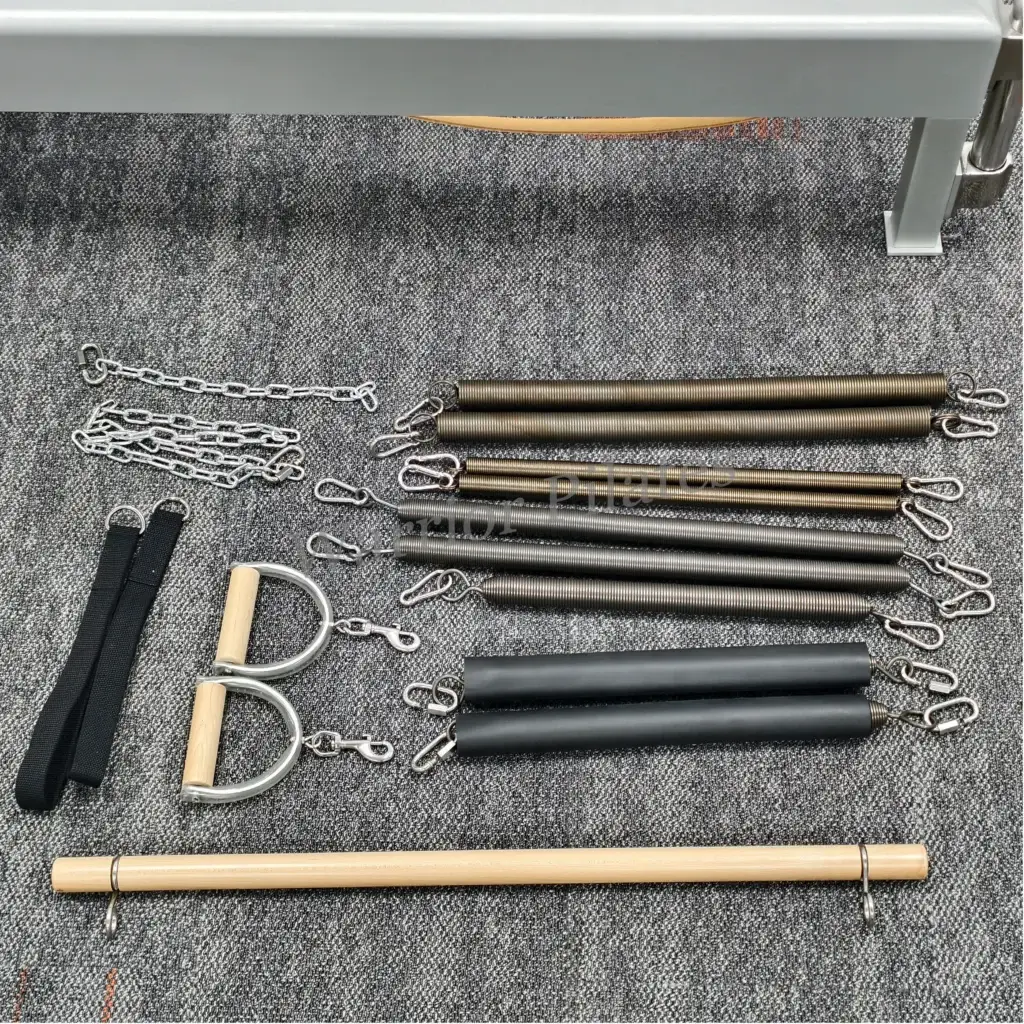
As a professional Pilates studio supplier, Warrior Pilates will provide an additional number of Pilates springs as a spare when customers purchase Pilates equipment. In addition, for reformers’ wheels, ropes, and Straps, we will also provide free backups.
Are the Springs Compatible with Other Brands?
Yes! Many studio owners need replacement springs that fit their existing reformers without modifying the equipment. Warrior Pilates manufactures replacement springs compatible with many leading commercial Pilates systems, including Balanced Body®, Merrithew®, and many classical Pilates reformers. As a result, instructors and studio owners using these training systems frequently purchase replacement springs from Warrior Pilates rather than replacing the entire reformer.
Maintenance Information Adds Long-Term Value
One section I rarely see in competitor catalogues is spring maintenance.
For commercial buyers, this information is just as valuable as the technical specifications.
A professional catalogue should recommend inspection and replacement intervals based on equipment usage.
A professional catalogue should also include spring replacement recommendations. For high-frequency commercial studios, springs are typically replaced every 12 months. For studios with moderate use, replacement every 24 months is generally recommended.
It should also explain the common signs of spring wear, including:
- Reduced resistance
- Unusual noise during movement
- Bent hooks or distorted coils
- Coil separation or visible gaps
- Springs that compress unevenly when unloaded
Providing this guidance helps studio owners establish preventive maintenance schedules instead of waiting for spring performance to decline.
How Spring Diameter and Coil Design Affect Reformer Performance
Many buyers believe that spring resistance is determined by spring color.
From an engineering perspective, color is only an identification system. The actual performance of a Pilates spring depends on its mechanical design. Among all design parameters, wire diameter, coil diameter, active coil count, and spring index have the greatest influence on how a reformer feels during use. (https://www.machinedesign.com/mechanical-motion-systems/article/21836997/sizing-up-the-choices-in-coil-spring-designs)
Together, these factors determine the spring’s stiffness, resistance curve, load capacity, fatigue life, and carriage control. Even springs with the same color can perform differently if their engineering specifications are not the same.
Wire diameter and coil design are the key factors that determine a Pilates reformer spring’s resistance, durability, and movement quality. Pilates Studios should compare spring specifications instead of relying on spring colors alone.
Wire Diameter Has the Greatest Influence on Spring Performance
If I could evaluate only one spring specification, I would choose wire diameter.
A small change in wire thickness creates a significant change in spring stiffness. Thicker wire produces a higher spring rate, allowing the spring to carry greater loads while resisting permanent deformation. It also reduces stress during each extension cycle, improving fatigue life under high-frequency commercial use.
For busy Pilates studios, this means a thicker spring generally maintains more stable resistance over time and requires fewer replacements.[https://www.centuryspring.com/resources/spring-wire-diameter]
Coil Design Controls How the Reformer Feels
Wire diameter determines how strong the spring is, while coil design determines how the movement feels.
Three design factors work together:
- Coil diameter influences spring flexibility.
- Active coil count affects how smoothly resistance builds.
- Spring index balances strength, durability, and manufacturing quality.
A larger coil diameter usually creates a softer, more progressive resistance. A smaller diameter increases stiffness and produces a firmer carriage feel.
Similarly, springs with more active coils tend to deliver smoother, longer movement, while fewer coils create a shorter and more direct resistance curve.
Professional manufacturers optimize these dimensions together rather than adjusting only one parameter.
What Commercial Buyers Should Compare
Instead of comparing spring colors, I recommend asking suppliers about the engineering behind the spring.
A professional manufacturer should be able to explain:
When evaluating a Pilates reformer spring, I usually focus on four engineering specifications:
- Wire diameter determines the spring’s stiffness, load capacity, and fatigue life. Even a small increase in wire thickness can significantly change how the reformer feels during use.
- Coil diameter influences how resistance builds throughout the movement. Larger coils generally create a softer, more progressive feel, while smaller coils produce firmer resistance.
- Active coil count affects carriage travel and movement quality. More active coils usually provide smoother, longer movement, while fewer coils create a shorter and more direct resistance curve.
- Spring index balances strength, durability, and manufacturability. A well-designed spring index helps deliver consistent resistance while extending the spring’s service life.
These specifications tell far more about spring quality than a simple color chart.
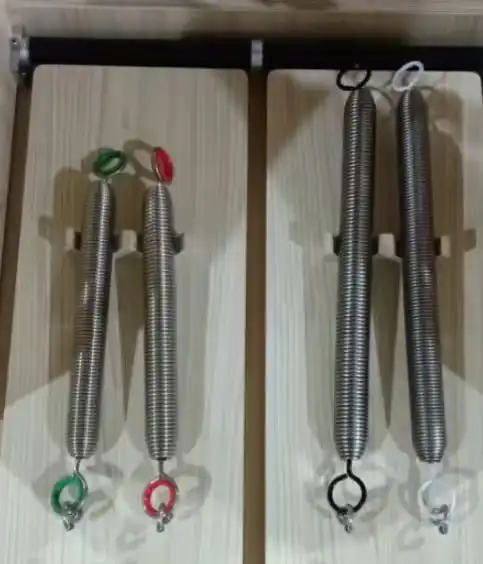
How Spring Length Influences Pilates Reformer Resistance and Carriage Feel
Many buyers compare spring resistance by looking only at the spring color or wire diameter.
From an engineering perspective, that tells only part of the story.
Spring length is equally important.
Two springs made from the same steel, with the same wire diameter and the same color, can produce completely different training experiences if their lengths are different.
Spring length changes how quickly resistance builds, how smoothly the carriage moves, and how the reformer feels throughout the entire range of motion.
For commercial buyers, understanding this relationship helps explain why two reformers with similar specifications may perform very differently in daily studio use.
Spring length directly influences resistance progression, carriage travel, and movement quality. Commercial buyers should evaluate spring length together with spring rate, wire diameter, and coil geometry instead of considering each specification separately.
Spring Length Changes the Resistance Curve
A Pilates reformer spring does not provide constant resistance.
Its resistance increases as the spring extends.
The original length of the spring determines how quickly that resistance builds during movement.
Generally speaking:
- A longer spring stretches over a greater distance and often creates a smoother, more progressive resistance curve.
- A shorter spring reaches higher tension more quickly, making the carriage feel firmer earlier in the movement.
Neither design is automatically better.
Each creates a different training experience.
The manufacturer’s goal is to match the spring characteristics to the intended reformer design.
Spring Length Influences Carriage Feel
Commercial buyers often describe reformers using words like:
- Smooth
- Progressive
- Stable
- Firm
- Responsive
Many people believe these characteristics come from the carriage or bearings.
In reality, the spring contributes just as much.
A well-designed spring length allows resistance to increase gradually.
This creates smooth transitions throughout the exercise and gives instructors better control during both the concentric and eccentric phases of movement.
If the spring reaches high tension too early, the carriage may feel abrupt during the beginning of the exercise.
If the spring is excessively long for the frame design, the movement may feel less responsive.
Good engineering balances these characteristics carefully.
Spring Length Must Match the Entire Reformer
One mistake I sometimes see is buyers comparing spring length without considering the complete machine.
Spring length is never designed independently.
It must match:
- Frame dimensions
- Rail length
- Carriage travel
- Spring attachment position
- Pulley geometry
- Exercise range
Changing only the spring length without redesigning these components may alter the intended movement characteristics.
This is why professional manufacturers engineer the entire resistance system as one integrated design rather than selecting springs independently.
Longer Pilates Spring Does Not Mean Better
Many buyers naturally assume a longer Pilates spring must provide smoother movement.
That is not always true.
Commercial performance depends on the relationship between several engineering parameters.
A properly designed spring combines:
- Correct free length
- Appropriate wire diameter
- Optimized coil geometry
- Accurate spring rate
- Controlled manufacturing tolerance
These factors work together.
Focusing on only one specification rarely produces the best commercial performance.
Conclusion
Throughout my career, I have learned that many buyers pay close attention to the frame, carriage, and upholstery of a Pilates reformer, yet spend very little time evaluating the springs.
I believe that should change.
The spring system is the heart of every reformer. It determines resistance, controls carriage movement, influences teaching consistency, and affects long-term maintenance costs. For commercial studios, spring quality is just as important as frame quality.
When comparing suppliers, I encourage buyers to look beyond spring colors or marketing descriptions. Instead, evaluate the engineering behind the springs.
Ask about:
- Spring steel quality
- Wire diameter
- Heat treatment
- Fatigue testing
- Replacement support
- Quality inspection procedures
These details reveal how the springs will perform after years of commercial use—not just on the day the reformer is delivered.
One lesson has remained constant throughout my twenty years in commercial manufacturing.
The best reformers are not built from the most expensive components.
They are built from components that work together as one complete system.
That includes the frame, carriage, rails, bearings, and, most importantly, the springs.
If you choose a manufacturer that understands this engineering philosophy, you are not simply purchasing Pilates equipment.
You are investing in consistent training, lower operating costs, safer equipment, and a better long-term experience for every instructor and every client.